Live · Solo-built · Growing
StrangerChat
Anonymous conversation, rebuilt so it is safe enough to keep using.
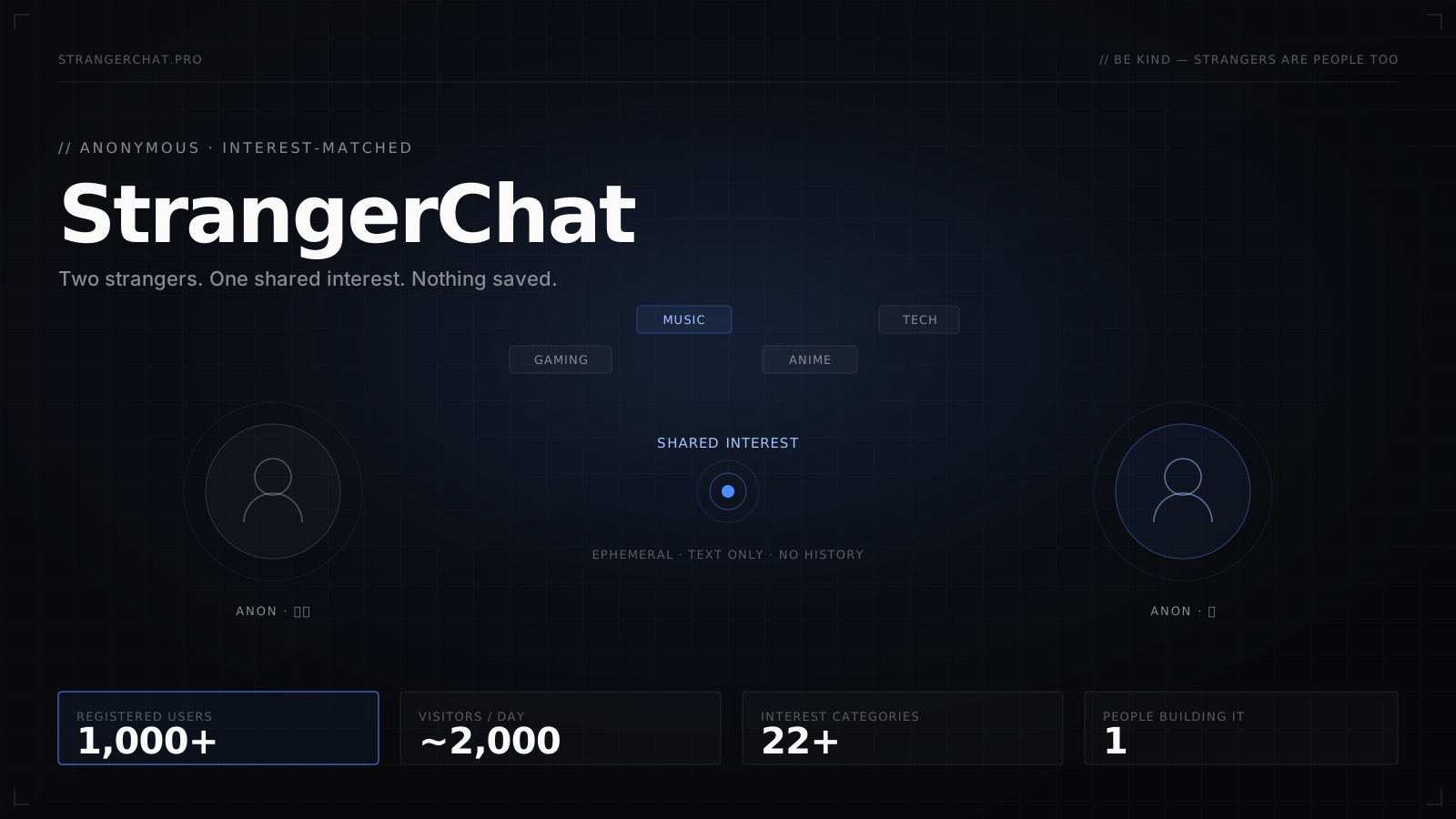
// TL;DR
Omegle shut down in November 2023 and took the largest anonymous-conversation product on the internet with it. The demand did not go anywhere — it scattered across video-first clones that inherited exactly the problems that killed the category. StrangerChat is the deliberate opposite: text-only, sign-in gated, interest-matched, and ephemeral. It is live, at 1,000+ registered users and roughly 2,000 visitors a day, and every layer of it — matching engine, auth, moderation tooling, interest taxonomy, SEO surface, premium tier — was built by one person alongside a full-time job.
The category leader died, and everything that replaced it repeated the mistake.
Talking to a stranger is one of the oldest uses of the internet and one of the few that never got a good product. Omegle carried that demand for fourteen years and then shut down in November 2023, with its founder explicitly citing the cost of fighting misuse. What filled the vacuum was a wave of clones that copied the surface — random pairing, instant entry, video-first — without touching the thing that made the original unsustainable. The result is a category where the product experience for a normal person is: enter, get matched with a bot or something you did not consent to see, close the tab. Demand is enormous and completely unserved by anything you would recommend to a friend.
People who want a conversation, not an audience.
The user I am building for is not looking for followers, matches, or content. They want twenty minutes of talking to someone new about something they both care about, with no obligation afterwards. That user has been priced out of the category by harm — not by product quality — and they are the easiest user in the world to win back if the room is clean.
- Adults who are lonely in a specific, ordinary way — new city, odd hours, remote work — and want a low-stakes conversation rather than a friendship funnel
- Interest-first talkers who would rather find one person who cares about the same niche than broadcast into a feed that does not answer
- People pushed out of the category by the video-first products, who want the format without the exposure
The demand signal is loud. The trust signal is the whole game.
I did not need to validate whether people want to talk to strangers — a fourteen-year incumbent and its search volume settled that. What I needed to understand was why every product serving that demand becomes unusable, and the answer was consistent across every alternative I used: zero-friction anonymous entry is what makes bots free, and video is what makes harm instant and irreversible. Both are growth features. Both are why the category has the reputation it has. The opening was not a better matching algorithm; it was being the one product in the category willing to give up growth features in exchange for a room worth staying in.
// Signals
- Omegle shut down in November 2023 after fourteen years, with moderation cost cited directly — the demand outlived the product
- Every major successor I tested is video-first with anonymous entry, reproducing both of the failure modes that ended the incumbent
- The first-session failure in every one of them is the same: matched with a bot, or with something you did not agree to see, inside thirty seconds
- Search demand for the category is stable and largely intent-driven — which means distribution can be earned rather than bought
Constraints are the product. Everything I removed is why it works.
The bet is that in an anonymous product, the features you refuse to ship matter more than the ones you do. Text-only removes the largest source of harm in the category outright. Mandatory sign-in costs conversion at the top of the funnel and buys a room without bots — the single thing that determines whether a matching product has any value at all. Interests as the matching key solve the real first-session problem, which is not "who do I talk to" but "what do I say first". Ephemerality means nothing survives the conversation, which is why people are willing to be honest inside it. Each of these is a growth feature I gave away deliberately, and together they are the only defensible position in a category that is otherwise a commodity.
// We said NO to
- Video — the growth cheat code in this category, and the reason the category has its reputation
- Anonymous zero-friction entry — every bot-free room in the world is behind an auth wall
- Profiles, photos, and persistent identity — they turn a conversation into a performance
- Stored chat history — it would improve personalization and destroy the reason people speak freely
- Paid acquisition — a consumer product that cannot grow without buying users is not a company yet
A matching engine, a clean room, and a distribution surface — all built solo.
StrangerChat pairs two signed-in strangers who share at least one declared interest and gives them a text-only room. You see a country flag, a gender, and what you have in common — nothing else. Either side can hit Next and be re-matched immediately, or report and block. When the chat ends, it is gone. The surface area is small on purpose: the entire product is one loop, and every engineering hour goes into making that loop clean rather than into features that widen it.
A 22-category taxonomy is the matching primitive rather than metadata. Pairing on a shared interest hands both people their first sentence, which is the only real bottleneck in the first thirty seconds of an anonymous conversation.
Google or email sign-in is mandatory. It is the single most expensive product decision on the site in funnel terms and the single highest-return one in experience terms — it is what makes a bot-free room possible at all.
Report and block are in the room, not buried in settings, and text-only means every report is reviewable evidence rather than a claim about something nobody can see. The moderation model is a design consequence, not a headcount problem.
Conversations are not persisted after they end. It closes off personalization and re-engagement mechanics, and it is the reason the conversations are worth having.
The interest taxonomy doubles as the site's indexable surface. Distribution was architected before the matching engine, which is why ~2,000 people a day arrive without a rupee of paid acquisition.
An optional tier adds gender and country filters and priority matching. It exists to pay for servers and to prove willingness-to-pay early — not to gate the core loop, which stays free.
What we deliberately gave up — and what we kept in exchange.
Video is the fastest growth lever available in this category and the direct cause of its reputation. Cutting it caps the top of the funnel and removes the largest source of harm — which is the only thing that makes the product recommendable, and therefore the only thing that makes it compound.
Instant entry converts better on every dashboard and guarantees a bot-filled room. In a matching product, one bad match in the first session ends the relationship permanently. I took the conversion hit to protect the only moment that matters.
Random pairing is cheaper to build and produces two-message conversations. Requiring a declared interest adds friction at signup and produces conversations that survive the opening exchange.
Storing chats would unlock recommendations, re-engagement, and a data moat. It would also change what people are willing to say, which is the entire product. I gave up the moat for the behaviour.
A solo founder with no budget and no network has exactly one scalable channel. Architecting the indexable surface before the matching engine felt backwards while building it and is the reason there are users to match.
Live, growing, and paying for itself — with one person on it.
StrangerChat has 1,000+ registered users and roughly 2,000 visitors a day, entirely from organic search and word of mouth, with no paid acquisition and no launch push. It is running as a real product with real moderation load, built and operated alongside a full-time PM role. The thing I care about most is not the number: it is that the constrained version of this product retains people that the unconstrained versions of it lose in the first thirty seconds.
What I'd carry forward.
// Stack