Live · Self-paced
PM OS
A flight simulator for product judgment.
// TL;DR
Most PM courses teach vocabulary, not judgment. PM OS is the opposite — six modules of decision simulators built like a flight trainer, designed so a new PM walks away with reps, not concepts. Free, account-less, dark-by-default, and tuned to feel like a command center rather than a classroom.
New PMs can recite frameworks. They can't make calls under ambiguity.
I reviewed twelve PM bootcamps and online certificates while planning this build. Every one of them taught the language of product management — RICE, JTBD, OKRs, OST — and every one of them tested vocabulary instead of judgment. The result was predictable: graduates who knew the words but stalled the moment a real call required them to commit to a bet with incomplete data. Hiring managers I spoke to confirmed the same gap from the other side of the table: "I can teach frameworks in a week. I can't teach judgment in a quarter."
Built for the people who need reps, not certificates.
PM OS is aimed at three audiences that share one trait — they learn faster by doing than by watching. The shared promise: when you finish a module, you should feel like you made a hundred small decisions, not that you read a hundred slides.
- Aspiring PMs who are tired of generic course material and want to feel the weight of a real call
- Engineers and designers transitioning into PM who need to internalize how ambiguity actually behaves
- Hiring managers who want a reusable training spine for the junior PMs joining their team
The retention gap is between knowing and deciding.
I interviewed eight PMs across seniority levels and read research on simulation-based learning in aviation and medicine. The pattern was consistent: people retain the skill that activates choice under risk, not the skill of being told what choice would have been right. Senior PMs almost universally pointed to one or two formative "had-to-decide-with-no-data" moments as the things that shaped them — and almost none could point to a course that had been similarly formative.
// Signals
- 8 / 8 senior PMs interviewed cited a "decide-with-no-data" moment as their formative training, not a class
- 12 popular PM courses surveyed — 11 lean >70% on lecture / reading content
- Aviation and medical training literature consistently shows simulation as the highest-retention modality
Strip the syllabus. Lean into simulation. Treat retention like a game designer would.
The thesis behind PM OS is that the highest-leverage thing a learning product can do is make the learner decide — repeatedly, in a low-stakes environment, with realistic friction. Borrow the streak loop from Duolingo because daily reps beat marathon weekends. Borrow the "command center" aesthetic from instrument panels because it sets the expectation that this is a tool, not entertainment. And keep the surface area aggressively small — no certificates, no badges, no community — so attention pays out as practice instead of vanity.
// We said NO to
- Paid tier — pricing would have filtered the user I most want to reach
- Certificates and badges — they re-create the vocabulary trap I'm trying to escape
- Account creation — every signup screen is a tax on the first session
- Cohort delivery — cohorts maximize peer learning but lose half the funnel to scheduling
Six modules, four simulators, a vault, and a streak.
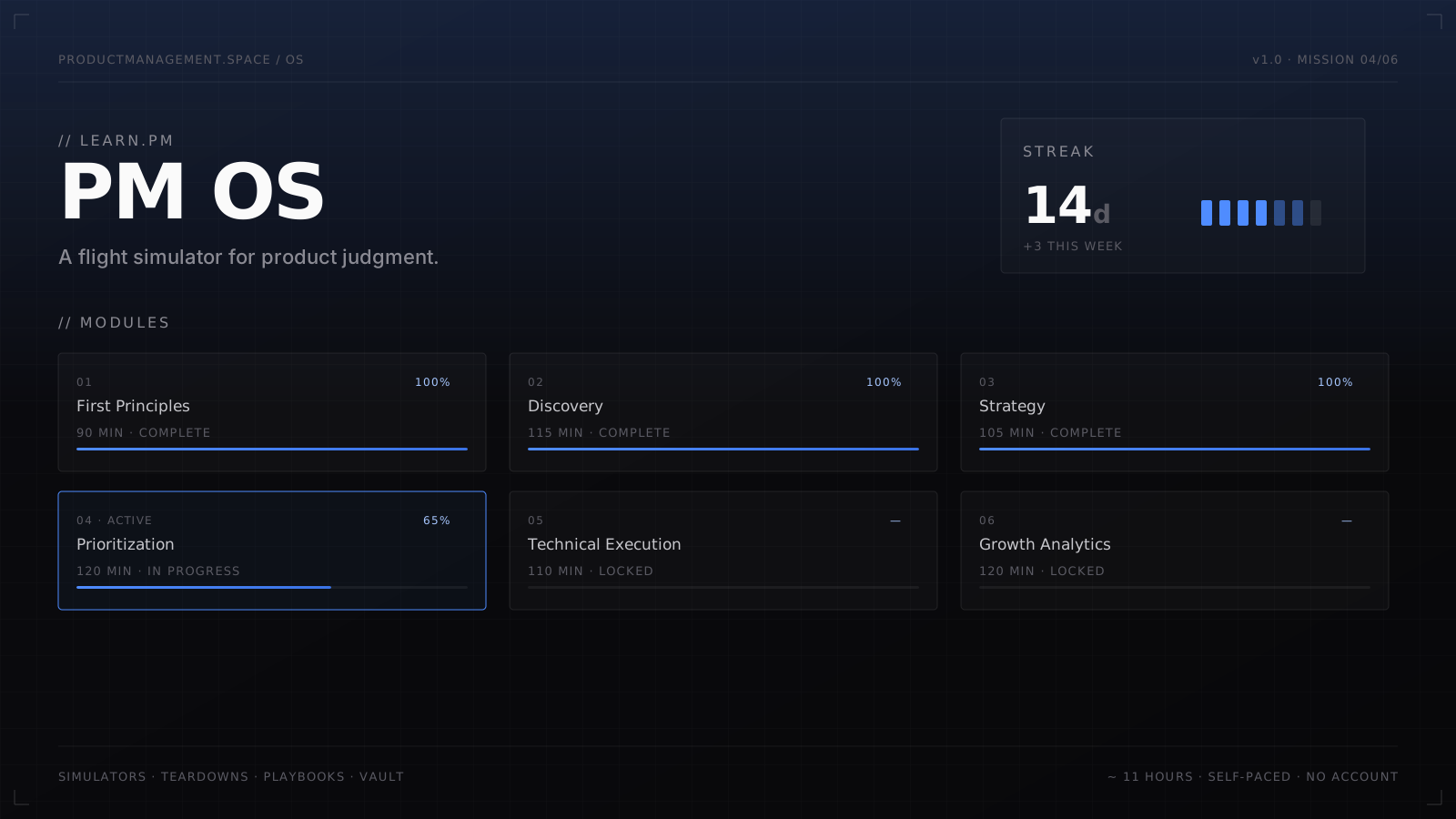
PM OS opens to a command-center home: a dark surface with module cards, a streak meter, and one big "continue where you left off" affordance. The user lands in whichever simulator they were last building intuition in — there is no welcome video, no glossary, no preamble.
First Principles, Discovery, Strategy, Prioritization, Technical Execution, and Growth Analytics. Each is bounded to 90-120 minutes — enough to feel substantial, short enough to finish on a weekend.
Decision exercises rendered as small instruments — a prioritization stack you sort by tension, an Opportunity Solution Tree builder, a hypothesis tree, a growth-loop simulator. Each one forces a commit before showing feedback.
Teardowns of products you already use — framed as "what would you do differently here, and why?" rather than "here's what they did."
A curated archive of templates, frameworks, and one-page artifacts the user can drop into their actual job tomorrow — no rebranding, no fluff.
A daily streak that rewards consistency over volume. Skips a day, the streak breaks. Borrowed wholesale from Duolingo — it's the most effective consumer-retention loop on the internet, and it costs nothing to implement.
What we deliberately gave up — and what we kept in exchange.
A login screen kills a quarter of first-time users in the first 10 seconds. The cost of "lost peer learning" is real, but the alternative is a much bigger funnel leak. I optimized for the first session.
The aesthetic signals seriousness. It loses some accessibility on first impression — a friendly illustration is less intimidating — but it filters in users who want a tool over an experience.
Certificates create the wrong incentive: optimize for completion, not retention. The same dynamic produced the courses I was trying to improve on.
A finite syllabus has an end state — the user can finish it. A growing library never does, which makes it feel like a chore instead of a track.
Live, with the right kind of return visits.
The product is in active distribution. Early qualitative signal: users describe the streak as the reason they come back — not the content — which is exactly what the retention thesis predicted. The simulators consistently get the strongest engagement; the reading-only sections are skimmed. That tells me the next iteration leans further into simulation.
What I'd carry forward.
// Stack