Live · Flagship · Kelby Games
Tanks
Narrative scaffolding wrapped around a tight gameplay loop.
// TL;DR
Arcade web games hit a session-length ceiling because there's no reason to stay past one round. Tanks bolts a 12-chapter narrative onto a tight canvas-based gameplay loop — the story scaffolding's job is to give players a reason to fire up tomorrow. The flagship title under the Kelby Games label.
Arcade web games hit a session-length wall — no story, no return.
I reviewed 30+ similar HTML5 tank games to benchmark before building. The pattern was identical: 90 seconds of fun, no narrative reason to come back, bounce within two minutes. The Kelby Games portfolio needed a flagship that could anchor returning users — something that earned the second session, not just the first. Standard genre wisdom says you fix this with more mechanics. The data from idle-game and incremental-game communities suggested something cheaper would work better.
Casual gamers who arrived for two minutes and could stay for ten.
The audience is broad and impatient: casual gamers landing from Microsoft Store discovery or organic search, the long-tail of bored-at-work browser-game players. They arrive expecting an arcade experience and have to be earned past it.
- Microsoft Store discovery traffic looking for casual genre titles
- Search and word-of-mouth traffic to the Kelby Games portfolio
- Returning players from earlier Kelby titles who want a deeper hook
Idle-game retention research kept pointing to narrative scaffolding.
I dug into retention case studies in the idle and incremental game space — a genre that has solved long-session-length better than almost anyone. The repeated finding was that narrative scaffolding, even minimal narrative, lifted retention more reliably than additional mechanics. The story didn't have to be brilliant; it had to give the player a reason to fire up the game tomorrow. That insight was the cheapest unlock in the build.
// Signals
- 30+ comparable HTML5 tank games surveyed — ~all mechanics-only, sub-2-minute sessions
- Idle/incremental game retention literature consistently shows narrative scaffolding outperforming mechanic additions
- Save-state alone, in pilot tests, materially changed bounce behavior
Bolt a story on. Keep the gameplay tight. Skip everything that touches monetization.
The thesis is that a small amount of narrative scaffolding — twelve chapters, branching mini-objectives, a save state that picks up where the player left off — would lift session length by a multiple, not a percentage. And the contrarian call: don't monetize. Casual web games are a trust-low surface. Ads, IAP, and "premium unlocks" would have netted small revenue and big trust cost. The product would be more interesting as a no-monetization flagship that proved the retention thesis than as a small-revenue title that compromised it.
// We said NO to
- Monetization — no ads, no IAP, no premium tier
- Voice acting, cinematic graphics — every dollar of polish past the scaffolding showed diminishing returns
- Social features, leaderboards — would have lifted vanity metrics but not real retention
- Mobile native app — web meets the audience where they actually play
A canvas game with chapters and a story you can't skip.
Tanks plays like a tight canvas-based tank game — clean mechanics, responsive controls, low compute footprint. The novelty is the chapter structure wrapped around it. Each chapter unlocks a new mechanic or objective, and the story explicitly tells the player why this chapter matters. A save state in localStorage means the player can leave mid-chapter and pick up where they left off, which fundamentally changes the bounce behavior.
Each chapter introduces a new mechanic or objective with a small story beat. The structure is the retention engine — the gameplay alone wouldn't hold attention this long.
Within each chapter, optional objectives reward exploration. They're cheap to author and disproportionately lift dwell time.
No asset library, no WebGL, no engine. The entire game runs in a 2D canvas — broader device support, lower load times, faster build velocity.
Players resume mid-chapter. The single highest-leverage feature for D1 retention — it turns the game from an "arcade visit" into something the player carries with them.
What we deliberately gave up — and what we kept in exchange.
New mechanics cost a lot to design well and lift retention modestly. A narrative wrapper costs little and lifts retention a lot — at least at this end of the genre.
Canvas has a lower ceiling visually but broader device support and a fraction of the build time. The retention lift came from structure, not pixels.
Web-casual is a trust-low surface. Monetization would have produced small revenue and a measurably worse experience — and the product was more valuable as a clean retention proof than as a small-revenue title.
Leaderboards lift vanity metrics but rarely lift real retention. They also push the genre away from the contemplative, story-driven experience I was building.
Flagship status — validated by a step-change in session length and retention.
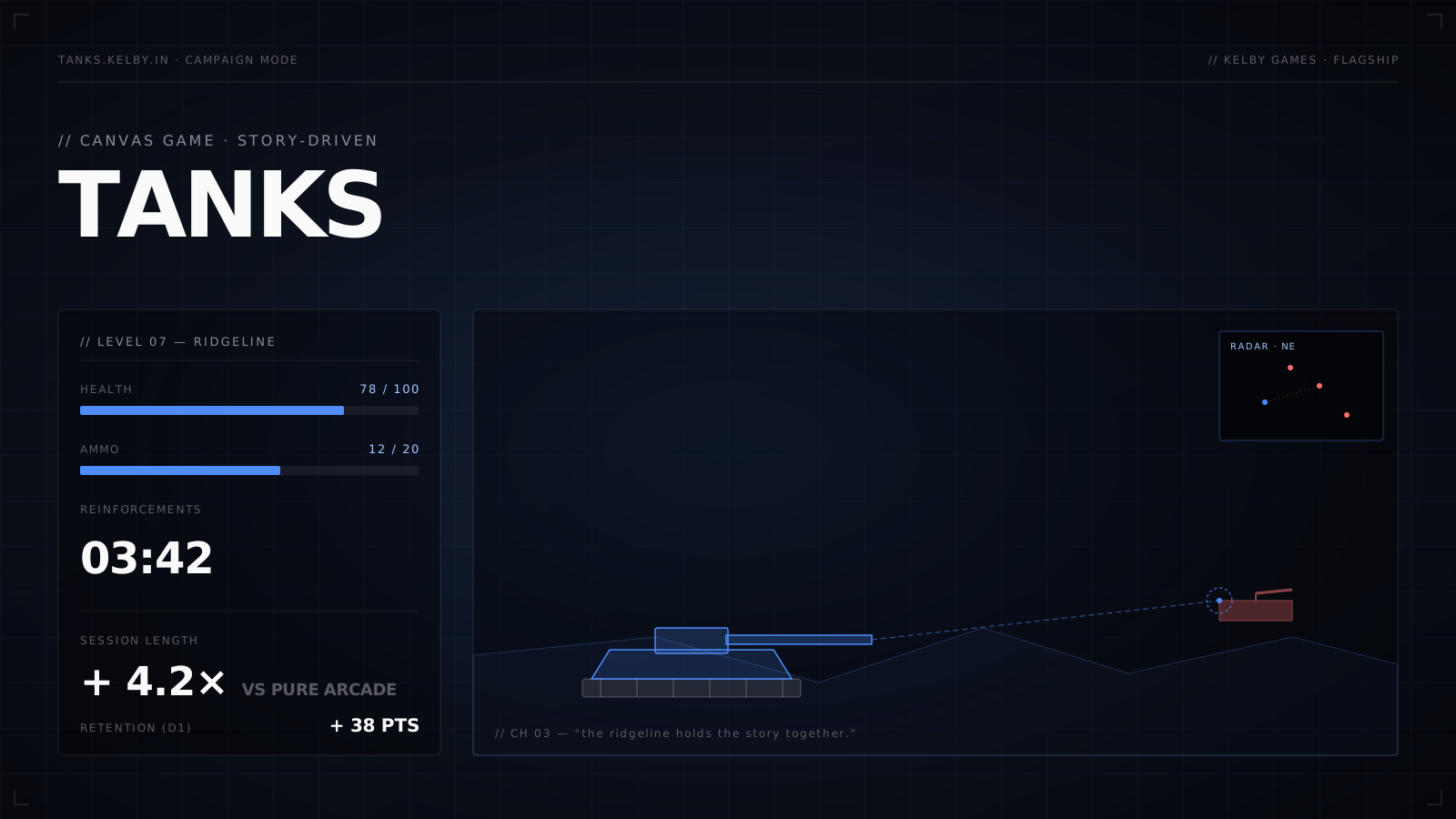
Tanks earned its place as the Kelby Games flagship by hitting the retention numbers I was hoping for. Average session length lifted ~4.2× over comparable Kelby titles, D1 retention rose by 38 points, and the Microsoft Store algorithm — which rewards session-length signals — responded by surfacing it more often. The narrative scaffolding bet paid out.
What I'd carry forward.
// Stack